
|
|

|
|
The New Mississippi Alabama & Gulf

Layout at a Glance
Name: Mississippi Alabama & Gulf - Cumberland Division
Scale: HO
Size: 24 X 32
Locale: Eastern Tennessee
Railroads: MA&G, L&N, Southern, Clinchfield
Period: Summer of 1968
Layout Height: 48 inches
Benchwork: L-Girder
Subroadbed: ½ inch plywood
Roadbed: Cork
Track: Atlas Code 83
Minimum Turnout: #6
Minimum Radius: 36 inches on Mainline
Landforms: Plaster cloth over cardboard webbing and Sculptamold
Scenery: Real dirt, ground foam, static grass, rubber rock faces
Backdrop: 1/4" Birch covered with foam core-backed commercial backdrops
Control: Digitrax Radio Super Chief

The Cumberland Division
Official Historical Compendium & Operations Synopsis
The modern corporate footprint of the Mississippi, Alabama & Gulf Railroad, nicknamed “The Magnolia Route”, is a testament to mid-century industrial ambition. Long established as a high-speed, water-level manifest pipeline hauling lumber, agriculture, and heavy chemical traffic across the deep south, the MA&G recognized the need to remain competitive during the 1950s. To secure its financial future against emerging industrial monopolies, the railroad desperately required an inland mountain division capable of tapping directly into the booming coal fields and heavy manufacturing centers of the southern Appalachian chain. The catalyst for expansion came via a series of aggressive corporate maneuverings. The MA&G systematically acquired controlling stock in several aging, landlocked short lines across East Tennessee and Southwest Virginia. Consolidating these fragmented rights-of-way, the MA&G laid heavy, high-poundage steel to construct a bold mountain corridor extending northeastward from its former northern terminus of Chattanooga. This aggressive engineering push culminated in the creation of the Cumberland Division, anchored by its new namesake terminus of Cumberland, Tennessee.
The Confluence at Cumberland: A Multi-Modal Empire
The geography of the division was dictated by the sheer volume of Appalachian manufacturing. Rather than routing into a dry mountain pass, the MA&G engineers positioned the division's nerve center, Cumberland, precisely at the navigable headwaters of the Cumberland River. This turned the city into a hyper-active terminal hub where heavy rail corridors directly collided with commercial water shipping. By the late 1960s, Cumberland had evolved into a massive, multi-tiered industrial valley:
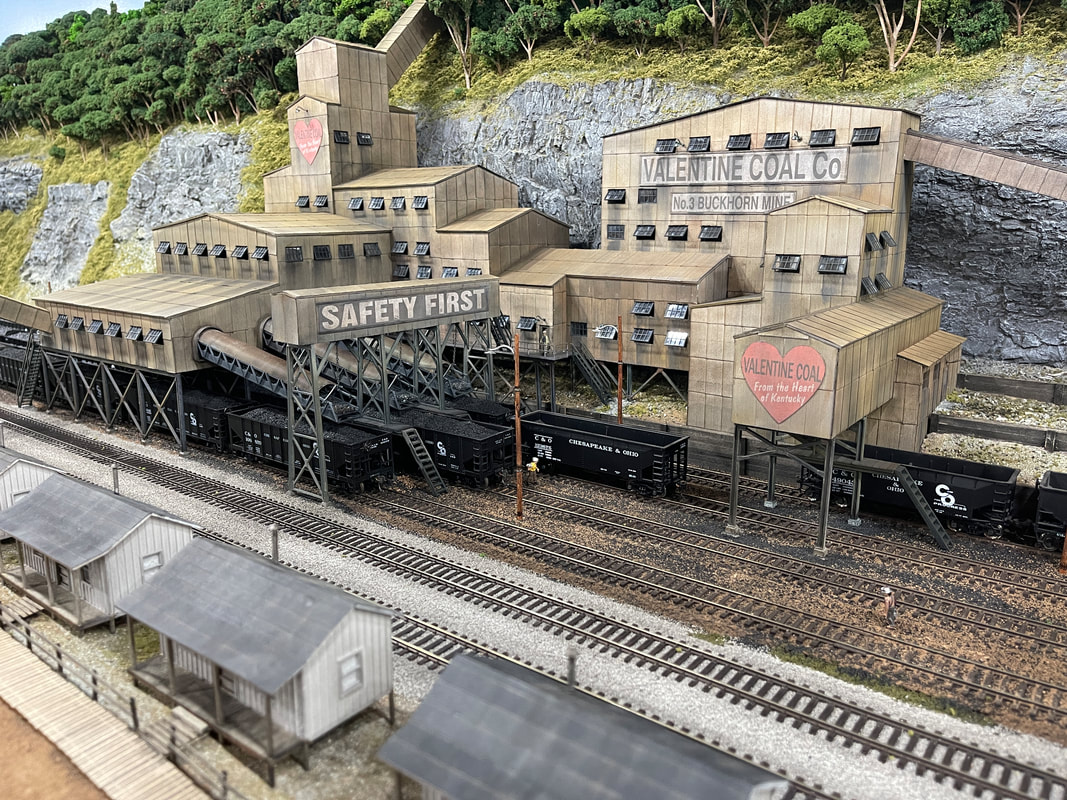
The lifeblood of the home-road operations remains the Valentine Coal Co. Prep Plant No. 3. Situated on the mainline at Buckhorn, TN, this massive centralized refining complex processes raw bituminous coal. To keep operations running with maximum efficiency, the MA&G operates this facility with absolute exclusivity. A dedicated Mine Run switcher shuttles continuous cuts of empty and loaded home road hoppers between the loading chutes and a high-capacity coal marshaling yard (Page Yard) hidden beneath Cumberland. Loaded unit coal trains are blocked and assembled at Page Yard, ready for MA&G power to haul them south via Chattanooga to destinations throughout the system.
The Lynchburg Pipeline and Clinchfield Alliance
To fuel the massive industries at Cumberland and secure a direct outlet to eastern markets, the MA&G developed an upper-level branch line from Middlesboro, KY to Lynchburg, VA. Piercing the Ridge-and-Valley province of the Appalachians, the line tracks across the horizon via an epic eight-span fixed truss bridge system over the wide river channel, climbing the sinuous mountain loops of Summit to cross into Virginia. By terminating the branch at Lynchburg, the MA&G embedded itself into the absolute epicenter of mid-Atlantic rail commerce. As a legendary three-way gateway controlled by the Norfolk & Western (N&W), the Chesapeake & Ohio (C&O), and the Southern Railway, Lynchburg serves as the economic engine for the entire division.
To break the rival Louisville & Nashville's fierce regional monopoly on coal routing, the MA&G forged a historic trackage rights agreement with the Clinchfield Railroad (CC&O). In exchange for general merchandise forwarding into the Lynchburg market, the Clinchfield secured the right to run heavy coal drags directly over the MA&G's upper-level high line into Middlesboro.
The Two-Level Staging Framework
The Cumberland Division's operating schedule is driven by a carefully balanced mix of home-road pride and fierce corporate rivalry, split cleanly across both decks. The lower Front Street classification yard is fed by three distinct staging pipelines. Heavy, long-distance MA&G manifests bring goods from the Gulf Coast via the 5-track Chattanooga Staging yard. A 4-track staging yard is evenly split to handle transfers from the MA&G's Lynchburg branch (Bulls Gap staging) as well as transfer runs from the Southern Railway via Knoxville. From the north, rugged Louisville & Nashville (L&N) shifters emerge from Pineville, KY Staging, crossing the state line and rolling through the Clinton waterfront before blowing their horns for the bascule lift bridges.
The upper deck branch line serves as an economic pipeline connecting Middlesboro Staging on the west end (the L&N Cumberland Valley gateway at the Kentucky border) to Lynchburg Staging on the east end (the multi-railroad Virginia network hub). Because this branch line features industrial spurs pointing in opposite directions, the MA&G operates turns between the two locations, with Bulls Gap staging simulating the connection between the two disconnected levels.
Official Historical Compendium & Operations Synopsis
The modern corporate footprint of the Mississippi, Alabama & Gulf Railroad, nicknamed “The Magnolia Route”, is a testament to mid-century industrial ambition. Long established as a high-speed, water-level manifest pipeline hauling lumber, agriculture, and heavy chemical traffic across the deep south, the MA&G recognized the need to remain competitive during the 1950s. To secure its financial future against emerging industrial monopolies, the railroad desperately required an inland mountain division capable of tapping directly into the booming coal fields and heavy manufacturing centers of the southern Appalachian chain. The catalyst for expansion came via a series of aggressive corporate maneuverings. The MA&G systematically acquired controlling stock in several aging, landlocked short lines across East Tennessee and Southwest Virginia. Consolidating these fragmented rights-of-way, the MA&G laid heavy, high-poundage steel to construct a bold mountain corridor extending northeastward from its former northern terminus of Chattanooga. This aggressive engineering push culminated in the creation of the Cumberland Division, anchored by its new namesake terminus of Cumberland, Tennessee.
The Confluence at Cumberland: A Multi-Modal Empire
The geography of the division was dictated by the sheer volume of Appalachian manufacturing. Rather than routing into a dry mountain pass, the MA&G engineers positioned the division's nerve center, Cumberland, precisely at the navigable headwaters of the Cumberland River. This turned the city into a hyper-active terminal hub where heavy rail corridors directly collided with commercial water shipping. By the late 1960s, Cumberland had evolved into a massive, multi-tiered industrial valley:
- The East-Bank Terminal Floor: Anchored by the sprawling classification tracks of Front Street Yard, this visible tier serves as the division's sorting engine. Here, inbound manifests are broken down, road power is serviced at the active turntable and roundhouse facility, and home-road MA&G crews block cars for local delivery or forwarding south to Chattanooga.
- The River District Industrial Core: Heavy industries on both the east and west banks of the shipping channel form the Cumberland River Industrial District. This heavy manufacturing sector hosts the sprawling Mountain State Paper Mill and the massive Collins Portland Cement Plant. To support the cement kilns, a continuous marine pipeline of towboats pushes raw limestone barges directly to the plant's dock cells, where an excavator mechanically unloads the aggregate. This east/west-bank tier is directly connected to the lower mainline, serving as a critical commercial destination for arriving transfers.
- The Movable Bridge Theater: Because the low-lying industrial tracks hug the water's edge, the lower mainline must cross the main shipping channel of the Cumberland River at a low clearance. To respect federal navigation laws, the Bridgemaster governs a spectacular trio of operating Scherzer and Strauss bascule lift spans. Rail traffic must routinely halt and hold at red interlocking signals to let commercial river barges glide past the industrial docks.
- The Elevated City Viaduct: High above Front Street Yard, a massive concrete and steel city viaduct cuts through the downtown skyline, supporting the tracks of Cumberland Union Station as well as spurs for Allied Wholesale Grocers and Anderson Brothers Tent and Awning Company. This upper-level through-corridor was designed to keep passenger traffic and heavy through freights moving fluidly past the congested classification tracks below.
The lifeblood of the home-road operations remains the Valentine Coal Co. Prep Plant No. 3. Situated on the mainline at Buckhorn, TN, this massive centralized refining complex processes raw bituminous coal. To keep operations running with maximum efficiency, the MA&G operates this facility with absolute exclusivity. A dedicated Mine Run switcher shuttles continuous cuts of empty and loaded home road hoppers between the loading chutes and a high-capacity coal marshaling yard (Page Yard) hidden beneath Cumberland. Loaded unit coal trains are blocked and assembled at Page Yard, ready for MA&G power to haul them south via Chattanooga to destinations throughout the system.
The Lynchburg Pipeline and Clinchfield Alliance
To fuel the massive industries at Cumberland and secure a direct outlet to eastern markets, the MA&G developed an upper-level branch line from Middlesboro, KY to Lynchburg, VA. Piercing the Ridge-and-Valley province of the Appalachians, the line tracks across the horizon via an epic eight-span fixed truss bridge system over the wide river channel, climbing the sinuous mountain loops of Summit to cross into Virginia. By terminating the branch at Lynchburg, the MA&G embedded itself into the absolute epicenter of mid-Atlantic rail commerce. As a legendary three-way gateway controlled by the Norfolk & Western (N&W), the Chesapeake & Ohio (C&O), and the Southern Railway, Lynchburg serves as the economic engine for the entire division.
To break the rival Louisville & Nashville's fierce regional monopoly on coal routing, the MA&G forged a historic trackage rights agreement with the Clinchfield Railroad (CC&O). In exchange for general merchandise forwarding into the Lynchburg market, the Clinchfield secured the right to run heavy coal drags directly over the MA&G's upper-level high line into Middlesboro.
The Two-Level Staging Framework
The Cumberland Division's operating schedule is driven by a carefully balanced mix of home-road pride and fierce corporate rivalry, split cleanly across both decks. The lower Front Street classification yard is fed by three distinct staging pipelines. Heavy, long-distance MA&G manifests bring goods from the Gulf Coast via the 5-track Chattanooga Staging yard. A 4-track staging yard is evenly split to handle transfers from the MA&G's Lynchburg branch (Bulls Gap staging) as well as transfer runs from the Southern Railway via Knoxville. From the north, rugged Louisville & Nashville (L&N) shifters emerge from Pineville, KY Staging, crossing the state line and rolling through the Clinton waterfront before blowing their horns for the bascule lift bridges.
The upper deck branch line serves as an economic pipeline connecting Middlesboro Staging on the west end (the L&N Cumberland Valley gateway at the Kentucky border) to Lynchburg Staging on the east end (the multi-railroad Virginia network hub). Because this branch line features industrial spurs pointing in opposite directions, the MA&G operates turns between the two locations, with Bulls Gap staging simulating the connection between the two disconnected levels.
